
En Passant in Chess Explained: Rules, Examples and Common Mistakes
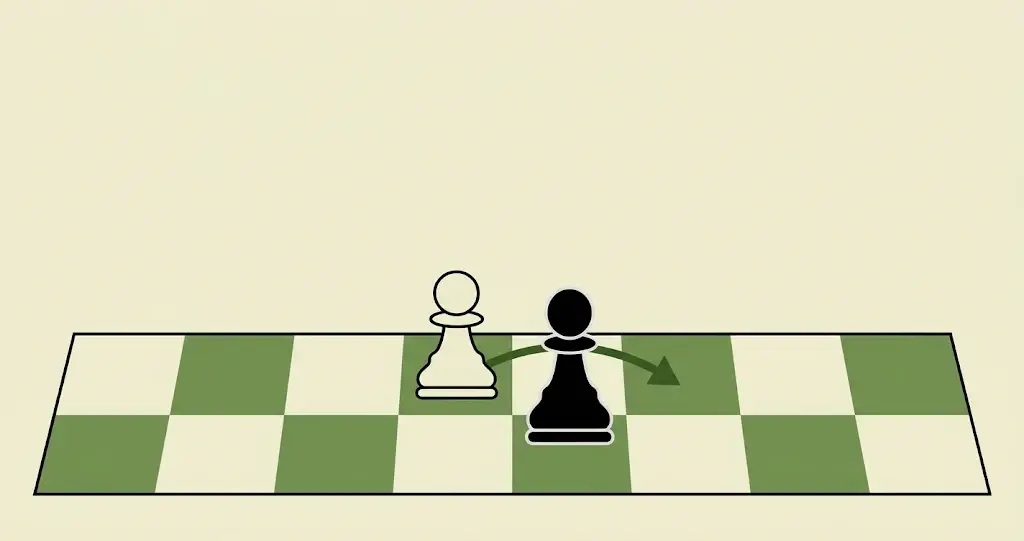
En passant is the rule that confuses almost every beginner. It is a special way for a pawn to capture another pawn, and it only works for one move. The name is French for “in passing,” and that is exactly what it describes: you capture a pawn as it passes by.
This guide explains en passant in chess with clear examples, the exact conditions, and the mistakes beginners make most often. If you are new to the game, read the basic chess rules first.
What is en passant?
En passant is a special pawn capture. It lets your pawn capture an enemy pawn that has just moved two squares forward and landed right beside it. You capture it as if it had moved only one square.
To remember it, think of it this way: the enemy pawn tries to sneak past your pawn by jumping two squares, and you are allowed to catch it as if it had only stepped one.
Why does the rule exist?
A pawn may move two squares on its first move. Without en passant, a pawn could use that two-square jump to slip past an enemy pawn that would otherwise have been able to capture it. The rule keeps things fair: moving two squares can’t be used to avoid a capture that one square would have allowed.
The en passant rule in 3 steps
- Your pawn is on its fifth row. For White, that is rank 5. For Black, that is rank 4.
- An enemy pawn next to it jumps two squares. The enemy pawn starts on its home row, moves two squares forward in one go, and lands right beside your pawn.
- You capture on your very next move. Your pawn moves diagonally forward, onto the square the enemy pawn jumped over, and the enemy pawn is removed from the board.
En passant example for White
Say White has a pawn on e5, and Black has a pawn on d7.
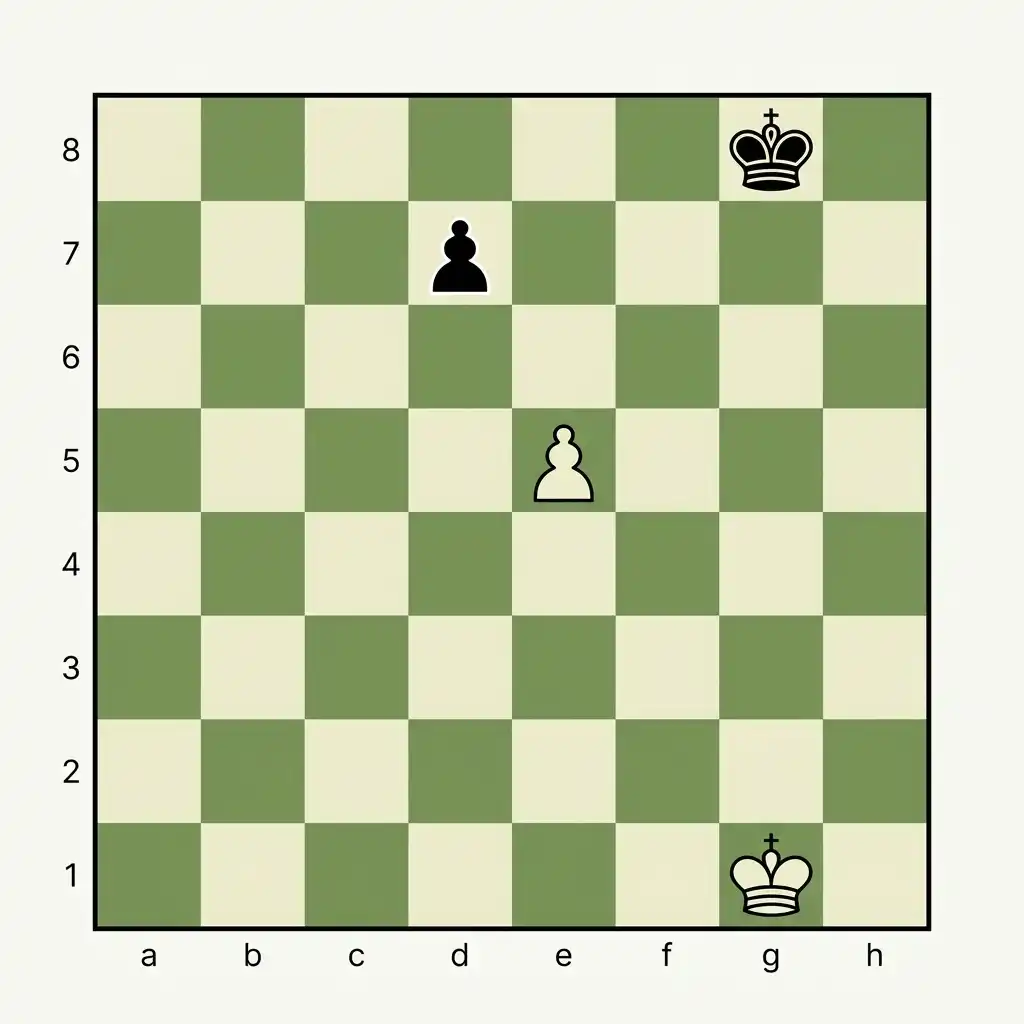
Black moves the pawn from d7 to d5, two squares forward. It lands right beside White’s pawn on e5.
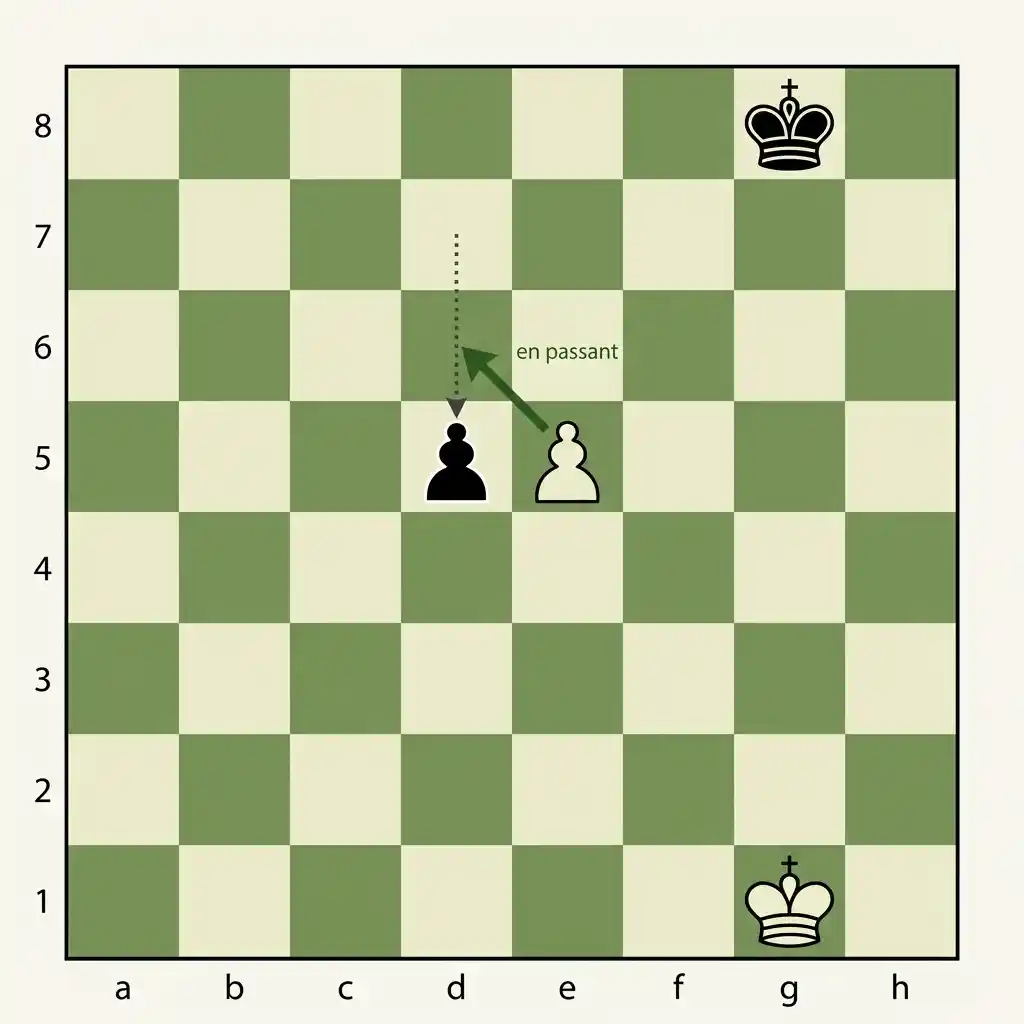
Now White can capture en passant. The white pawn moves diagonally from e5 to d6, the square the black pawn jumped over. The black pawn on d5 is removed, even though it was not on d6.
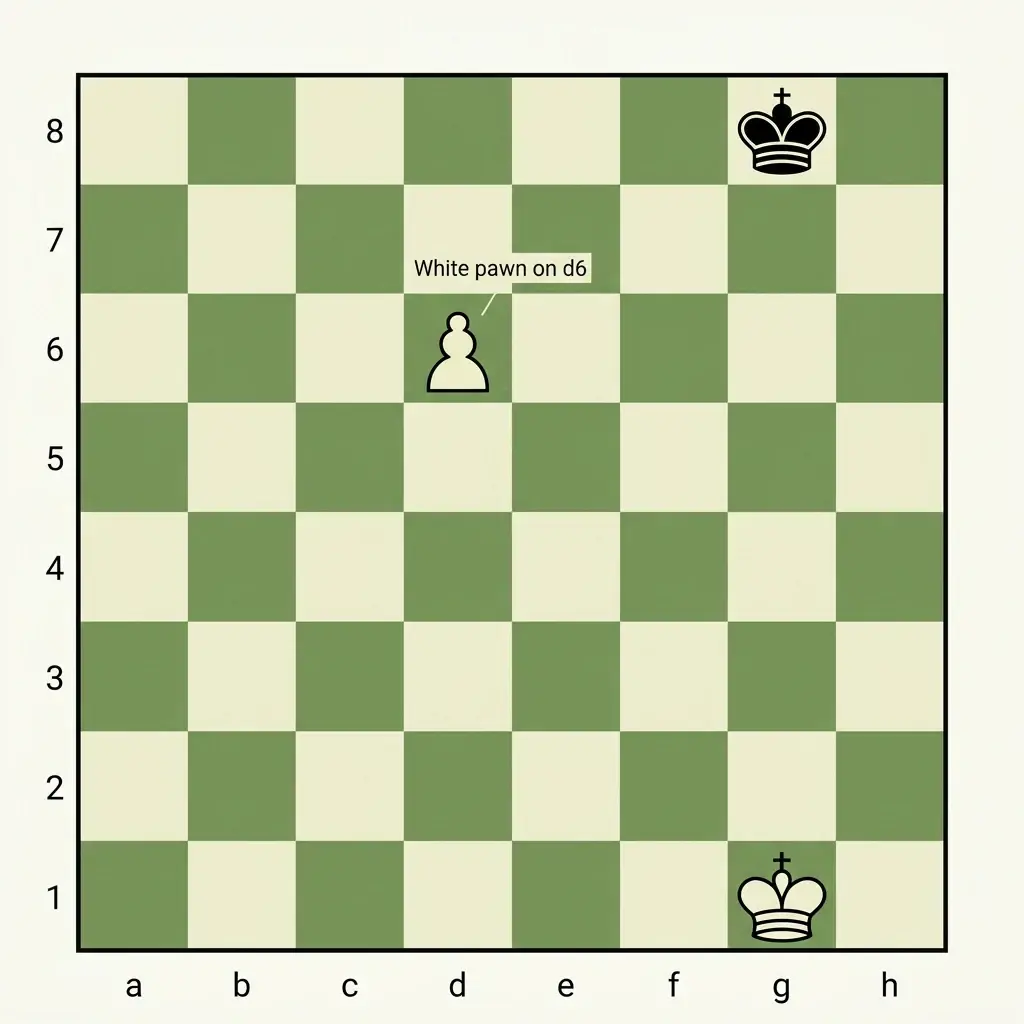
In notation, this move is written exd6 e.p.
En passant example for Black
It works the same way for Black. If Black has a pawn on d4 and White moves a pawn from e2 to e4, landing beside it, Black can capture en passant. The black pawn moves from d4 to e3, and the white pawn on e4 is removed.
En passant at a glance
| Question | Answer |
|---|---|
| Which pieces can use it? | Pawns only |
| Which pieces can be captured? | Pawns only |
| Which pawn can capture? | A pawn on its fifth row (rank 5 for White, rank 4 for Black) |
| What must the enemy pawn do? | Move two squares forward from its starting square in one move |
| Where does the capturing pawn land? | On the square the enemy pawn jumped over |
| When must you capture? | Immediately, on your next move |
| Is it required? | No, it is optional |
The conditions, one by one
All of these must be true:
- Only pawns are involved. You can’t capture a knight or a bishop en passant.
- The enemy pawn must have just moved two squares. If it moved one square at a time, en passant is not available, but you can capture it in the normal way.
- Your pawn must be right beside it. On the same row and on the next file, with no square in between.
- You must act immediately. If you play a different move, the chance is gone for good.
- It must be legal. Like any other move, en passant can’t leave your own king in check.
Do you have to capture en passant?
No. It is always your choice. If you don’t want to capture, play another move. Just remember that you can only capture en passant on the very next turn, so decide right away.
En passant on Chess.com, Lichess and apps
On most chess sites, the legal en passant capture is shown as a diagonal move for your pawn. Drag your pawn diagonally to the empty square behind the enemy pawn, and the site removes the enemy pawn for you. If the move isn’t offered, one of the conditions above isn’t met.
En passant and strategy
En passant is rare, but it matters. A few simple points:
- When you push a pawn two squares, check the squares beside it. If an enemy pawn sits next to your landing square, it can capture you en passant.
- Sometimes the capture is a bad idea, because it opens a file or pulls your pawn out of position. Look at the whole board before you take it.
- Sometimes pushing past is a good idea, because the capture helps you, and many strong players offer it on purpose.
For a wider look at how to plan your moves, read our guide to chess strategies for beginners.
Common en passant mistakes
- Capturing a turn too late. The right to capture lasts for one move only.
- Landing on the wrong square. Your pawn goes to the square the enemy pawn jumped over, not to the square where it stands.
- Using it against pieces. It works against pawns only.
- Using it with a pawn that is not on the fifth row. The capturing pawn must be right beside the enemy pawn after its jump.
- Forgetting it is optional. You don’t have to take.
- Thinking only White can do it. Both sides can capture en passant.
- Using it when it leaves your king in check. Like all moves, it must be legal.
Frequently asked questions
What does en passant mean in chess? It is French for “in passing.” It describes a pawn capturing another pawn as it passes by.
Is en passant forced? No. It is optional. If you don’t take it right away, you lose the chance.
Can any pawn capture en passant? Only a pawn standing right beside the enemy pawn after its two-square jump, and only on the very next move.
Can you capture a piece en passant? No. En passant works against pawns only.
Can you capture en passant later? No. You have exactly one move to do it.
Is en passant an official rule? Yes. It is part of the official rules of chess, and you can use it in every normal game.
Can you capture en passant if it leaves your king in check? No. A move that leaves your own king in check is never allowed.
What to learn next
Now that you know the special pawn capture, learn how each piece moves and what each piece is worth, and see how to castle in chess, the other special move you need to know.