
10 Basic Chess Rules Every Beginner Should Know
Chess looks complicated, but the rules fit on one page. You need to know how to win, how to take turns, what check means, and a handful of special moves. This guide explains each rule in plain language, with the mistakes beginners make most often.
If you haven’t yet, set up your board and learn how each piece moves first. Then come back here.
The rules at a glance
| Rule | In one line |
| The goal | Trap the enemy king so it cannot escape (checkmate) |
| Turns | White moves first, then players alternate, and you cannot pass |
| Capturing | Move onto an enemy piece’s square to remove it |
| Check | Your king is attacked, and you must deal with it at once |
| Castling | A special king and rook move for safety |
| En passant | A special pawn capture, available for one move only |
| Promotion | A pawn that reaches the far end becomes a stronger piece |
| Draw | A tie, which can happen in several ways |
Rule 1: The goal is checkmate
You win a game of chess by checkmating the other player’s king. Checkmate means the king is under attack and there is no legal way to escape. You don’t capture the king. The game simply ends once checkmate happens.
You can also win if your opponent resigns, or runs out of time in a timed game.
Rule 2: How turns work
- White always moves first.
- Players then take turns, one move each.
- You must move on your turn. You cannot pass, even if every move hurts you.
- You can move only one piece per turn. The only exception is castling, which moves two pieces as a single move.
Rule 3: How capturing works
To capture, move your piece onto the square of an enemy piece. The enemy piece is removed and yours takes its place. You cannot capture your own pieces, and you cannot skip over pieces, except with the knight. Pawns capture diagonally, not straight ahead.
Capturing is never forced in standard chess. You choose whether to capture, as long as the move is legal.
Rule 4: Check
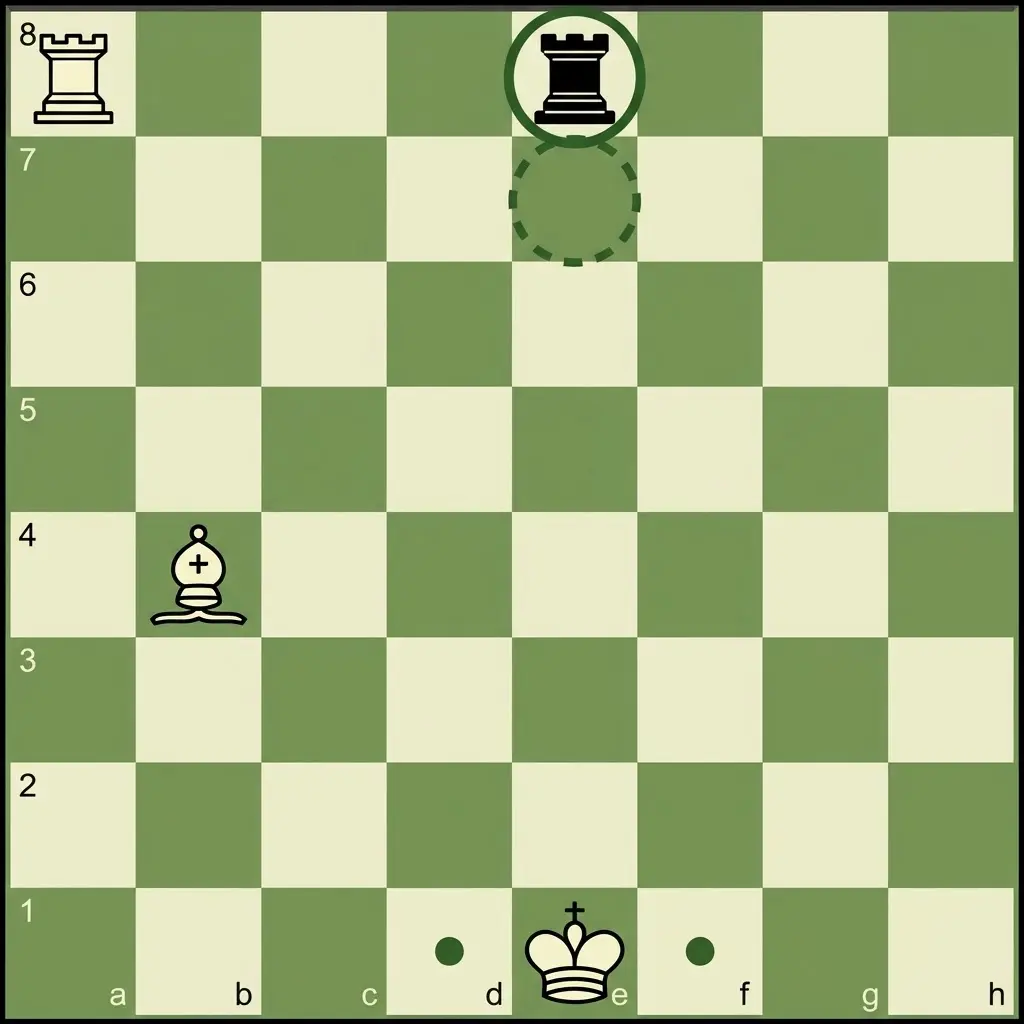
A king is in check when an enemy piece is attacking it. When you are in check, you must get out of it on your very next move. You have three ways to do that:
- Move the king to a square that is not attacked.
- Block the attack by putting a piece between the attacker and your king.
- Capture the piece that is giving check.
A check from a knight cannot be blocked, because knights jump. You must move the king or capture the knight.
Say “check” out loud if you like, but you don’t have to. In serious games it is optional.
Rule 5: Checkmate
If you are in check and none of the three escapes works, that is checkmate, and you lose. If you want to see how it happens, read our guide to basic checkmate patterns and the difference between check, checkmate and stalemate.
Rule 6: You can never leave your king in danger
You can’t make any move that leaves your own king in check. That has two practical effects:
- The king can’t move to an attacked square. Even if the square looks empty, you can’t step there.
- A pinned piece can’t move away. If a piece stands between your king and an attacker, moving it would expose your king, so that move is illegal.
If a move would put or leave your king in check, it simply isn’t allowed.
Rule 7: Castling
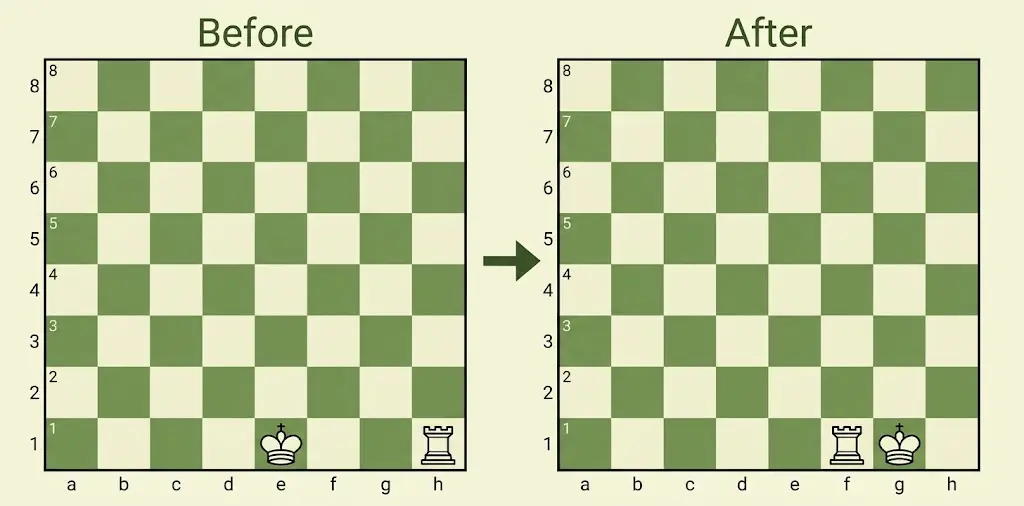
Castling is the only move where two pieces move at once. The king moves two squares toward a rook, and that rook jumps over to the other side of the king. It protects your king and brings a rook into the game.
You can castle only if all of this is true:
- The king and that rook have not moved yet during the game.
- There are no pieces between the king and the rook.
- The king is not in check right now.
- The king does not pass through or land on an attacked square.
Castling toward the nearer rook is called kingside (short) castling, and toward the farther rook is queenside (long) castling. For examples, see our castling guide.
Rule 8: En passant
En passant is French for “in passing.” It is a special pawn capture with strict timing:
- Your pawn must be on its fifth rank (the fifth row from your side).
- An enemy pawn moves two squares forward from its starting square and lands right beside your pawn.
- On your very next move, you may capture it as if it had moved only one square.
If you don’t capture right away, the chance is gone. See en passant explained simply for diagrams.
Rule 9: Pawn promotion
When a pawn reaches the last row on the far side of the board, it must be promoted. You replace it with a queen, rook, bishop or knight of your own color. You can’t keep it as a pawn, and you can’t turn it into a king. Almost everyone chooses a queen, which is why it is possible to have two or more queens. Read more in pawn promotion in chess.
Rule 10: Draws
Not every game has a winner. A game is a draw in these cases:
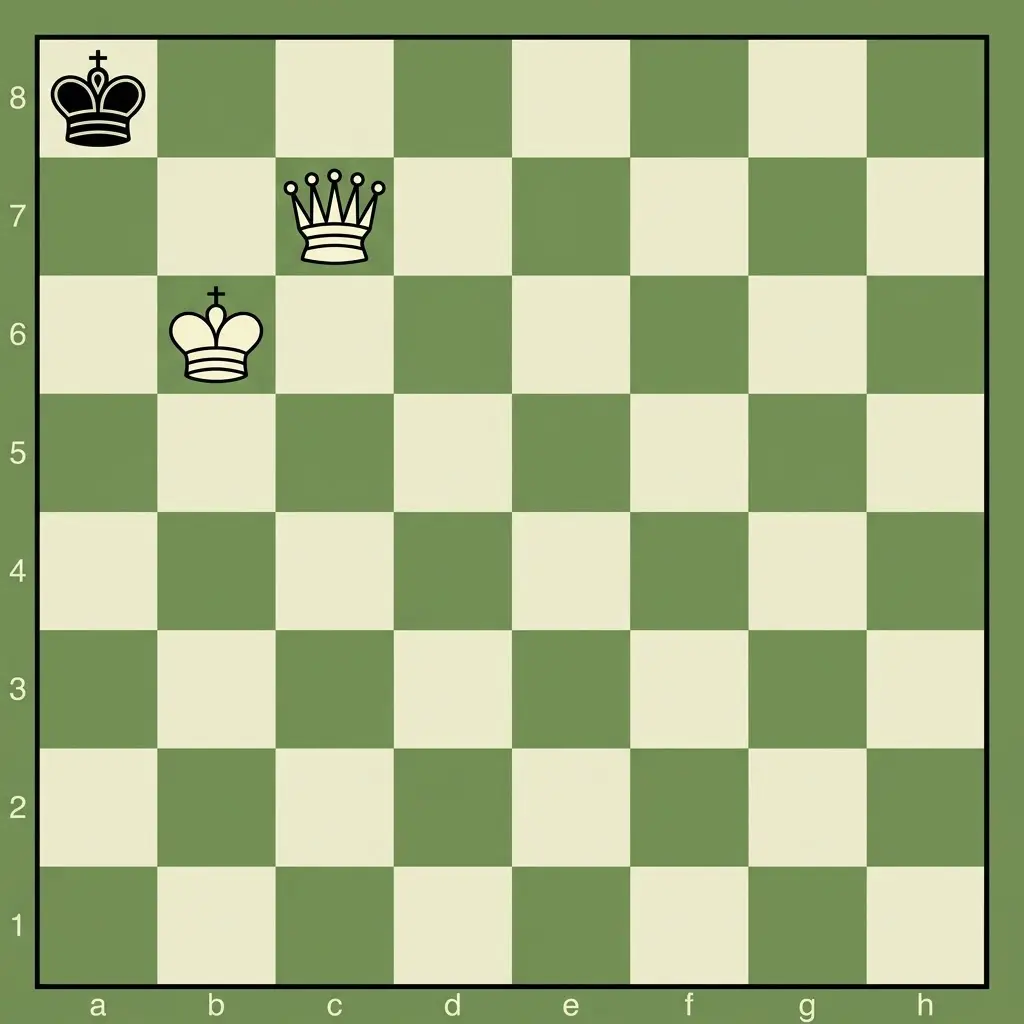
- Stalemate: the player to move is not in check but has no legal move.
- Insufficient material: neither side has enough pieces to checkmate, for example king against king, or king and bishop (or knight) against king.
- Threefold repetition: the same position appears three times, and a player claims a draw.
- Fifty-move rule: 50 moves by each player pass with no pawn move and no capture, and a player claims a draw.
- Agreement: both players agree to a draw.
Stalemate surprises many beginners. If you are winning and take away your opponent’s last legal move without giving check, the game is a draw, not a win.
Over-the-board etiquette
When you play on a real board, a few extra rules apply:
- Touch-move: if you touch one of your pieces, you must move it if you can. If you touch an enemy piece, you must capture it if you can.
- Move is final: once you let go of a piece on a square, the move is done.
- Adjust politely: if you want to straighten a piece, say “I adjust” first.
Online, you can often take back a move or play at any speed, depending on the site’s settings.
Common beginner mistakes
- Forgetting you are in check. Look at your king before every move.
- Moving into check. The game won’t allow it online, and it is illegal on a real board.
- Thinking stalemate is a win. It is a draw.
- Castling through check. The king can’t cross or land on an attacked square.
- Capturing en passant too late. You get one move only.
- Trying to pass. There is no passing in chess.
Frequently asked questions
Who moves first in chess? White always moves first.
What is the goal of chess? To checkmate your opponent’s king, which means trapping it so it can’t escape.
Can you castle out of check? No. You can’t castle while your king is in check, and you can’t castle through an attacked square.
Is stalemate a win? No. It is a draw.
Can a king capture a piece? Yes, if the piece is not protected. A king can’t capture anything that would leave it in check.
What to learn next
Once you know the rules, learn what each chess piece is worth so you can judge trades, and practice with a few free games against the computer. You will pick up these rules quickly by playing.