
Chess Pieces: Names, Moves and Values (Beginner Guide)
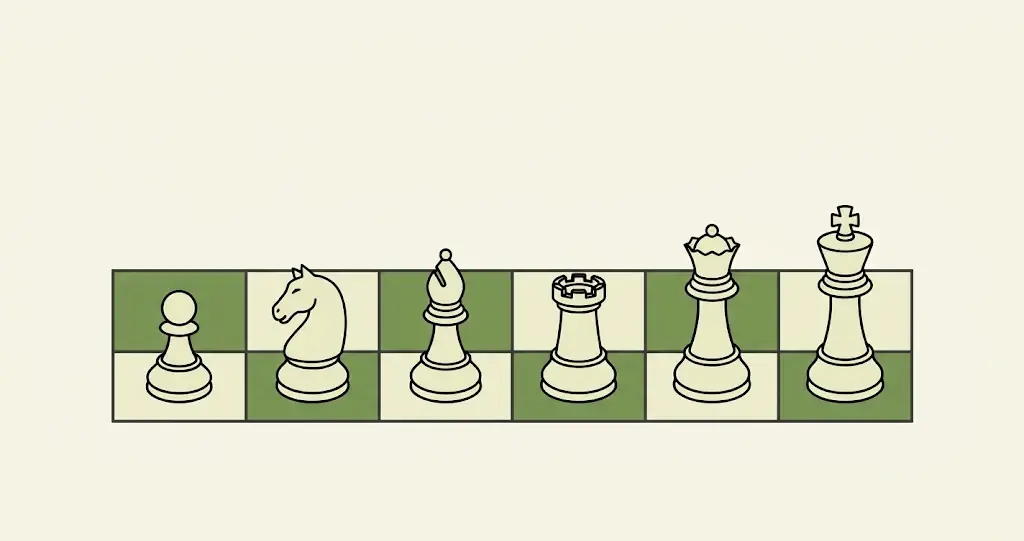
A chess set has 32 pieces, 16 for each player, and they come in six different types. Each type has its own name, its own way of moving and its own value. This guide introduces all of them: what they are called, what they look like, what each one does best, and how many points each is worth.
If you are new to the game, set up your board first, then use this page as your reference for the pieces.
The six chess pieces at a glance
| Piece | How many each | How it moves | Value |
|---|---|---|---|
| Pawn | 8 | Forward one square, captures diagonally | 1 point |
| Knight | 2 | In an L shape, and it can jump | 3 points |
| Bishop | 2 | Diagonally, any distance | 3 points |
| Rook | 2 | Straight lines, any distance | 5 points |
| Queen | 1 | Straight lines and diagonals, any distance | 9 points |
| King | 1 | One square in any direction | Priceless |
Each player therefore starts with 8 pawns, 2 knights, 2 bishops, 2 rooks, 1 queen and 1 king, which makes 16 pieces. Together, both sides have 32.
The names of the chess pieces
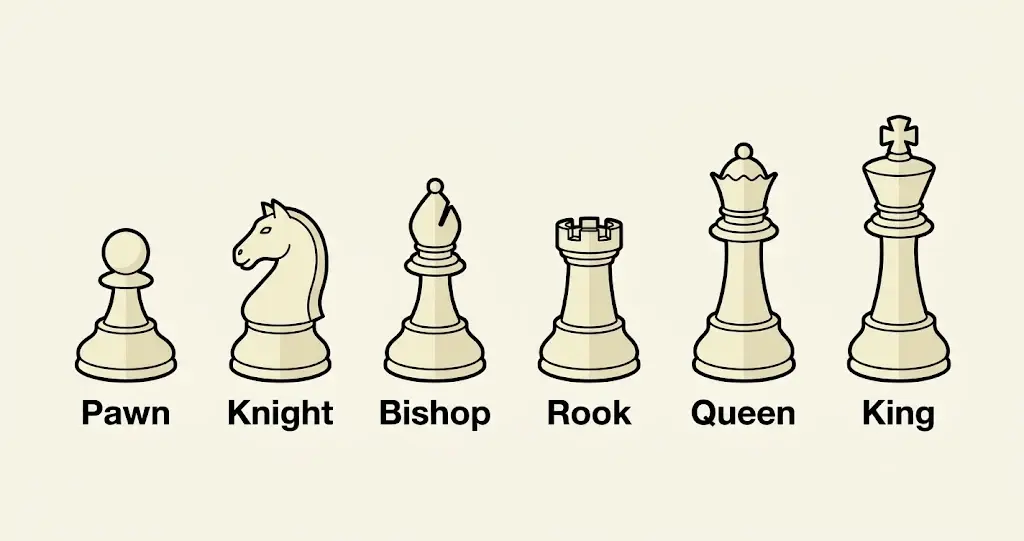
The six pieces are the king, queen, rook, bishop, knight and pawn. Beginners often use other names, and that is fine:
- The rook is sometimes called a castle, because it looks like a tower.
- The knight is often called the horse, because the piece is shaped like a horse’s head.
- The pieces together are sometimes called chess men or chessmen, and your two sides are usually called White and Black.
In written notation, each piece has a letter: K for king, Q for queen, R for rook, B for bishop and N for knight. Pawns have no letter. You will see these in game records, and you can learn more in our guide to reading chess notation.
Pieces by group
Players often group the pieces by how strong they are:
- Major pieces: the queen and the rooks.
- Minor pieces: the bishops and the knights.
- Pawns: the weakest pieces, but there are eight of them and they shape the whole game.
- The king: it is not counted with the others, because it cannot be traded.
The pawn
The pawn is the smallest and most numerous piece. It moves forward only, one square at a time (two squares on its first move), and it captures one square diagonally forward. Pawns are worth one point each, but they are important for another reason: when a pawn reaches the far end of the board, it can promote into a stronger piece, usually a queen. See how each piece moves for the full rules.
The knight
The knight moves in an L shape and is the only piece that can jump over other pieces. That makes it very useful in crowded positions. Knights are strongest near the center of the board and weaker on the edges. A knight is worth about three points.
The bishop
The bishop moves diagonally, and each bishop stays on one color of square for the whole game. Bishops work best in open positions, where their long diagonals are clear. A bishop is also worth about three points, and two bishops together are especially strong because they cover both colors.
The rook
The rook moves in straight lines, any distance, forward, back or sideways. It is strongest on open files and ranks, which are lines with no pawns blocking them. Rooks usually become active later in the game. A rook is worth five points.
The queen
The queen is the most powerful piece. She combines the moves of a rook and a bishop, and she is worth about nine points. Because she is so valuable, don’t risk her early in the game for a small gain.
The king
The king moves one square in any direction, and it is the most important piece, because the game ends if it is checkmated. It has no point value, because you can never trade it. In the opening and middlegame, it should be kept safe, usually by castling. In the endgame, it becomes an active fighting piece.
Chess piece values
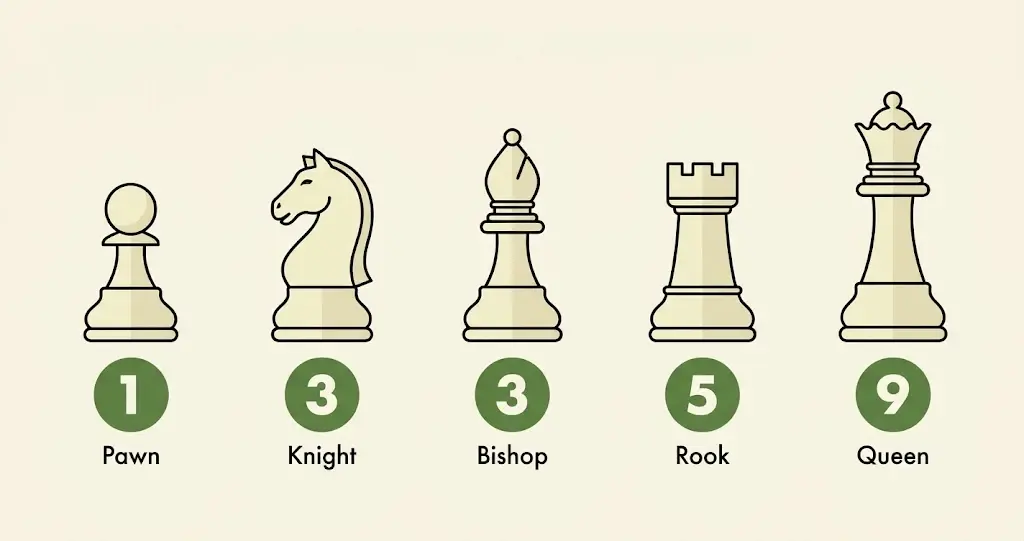
Piece values are a simple way to count who is ahead in material. They are only a guide, but they help you decide whether a trade is good or bad.
| Piece | Value |
|---|---|
| Pawn | 1 |
| Knight | 3 |
| Bishop | 3 |
| Rook | 5 |
| Queen | 9 |
| King | Not counted |
At the start of the game, each side has 39 points of material: 8 for the pawns, 6 for the knights, 6 for the bishops, 10 for the rooks and 9 for the queen.
How to use piece values
- Even trade: a knight for a bishop, or a rook for a rook, keeps things equal.
- Good trade: giving up a knight (3) to win a rook (5) puts you ahead by two points.
- Bad trade: giving up a rook (5) to win a knight (3) loses two points. Players call this losing the exchange.
- Queen trade: a queen (9) for a rook and a minor piece (8) is close to even, but queen for a single rook (5) is usually a mistake.
Values change with the position. A rook trapped behind its own pawns may be worth less than a strong knight, and a pawn about to promote may be worth much more than one point. Treat the numbers as a starting point, not a rule.
How the pieces start on the board
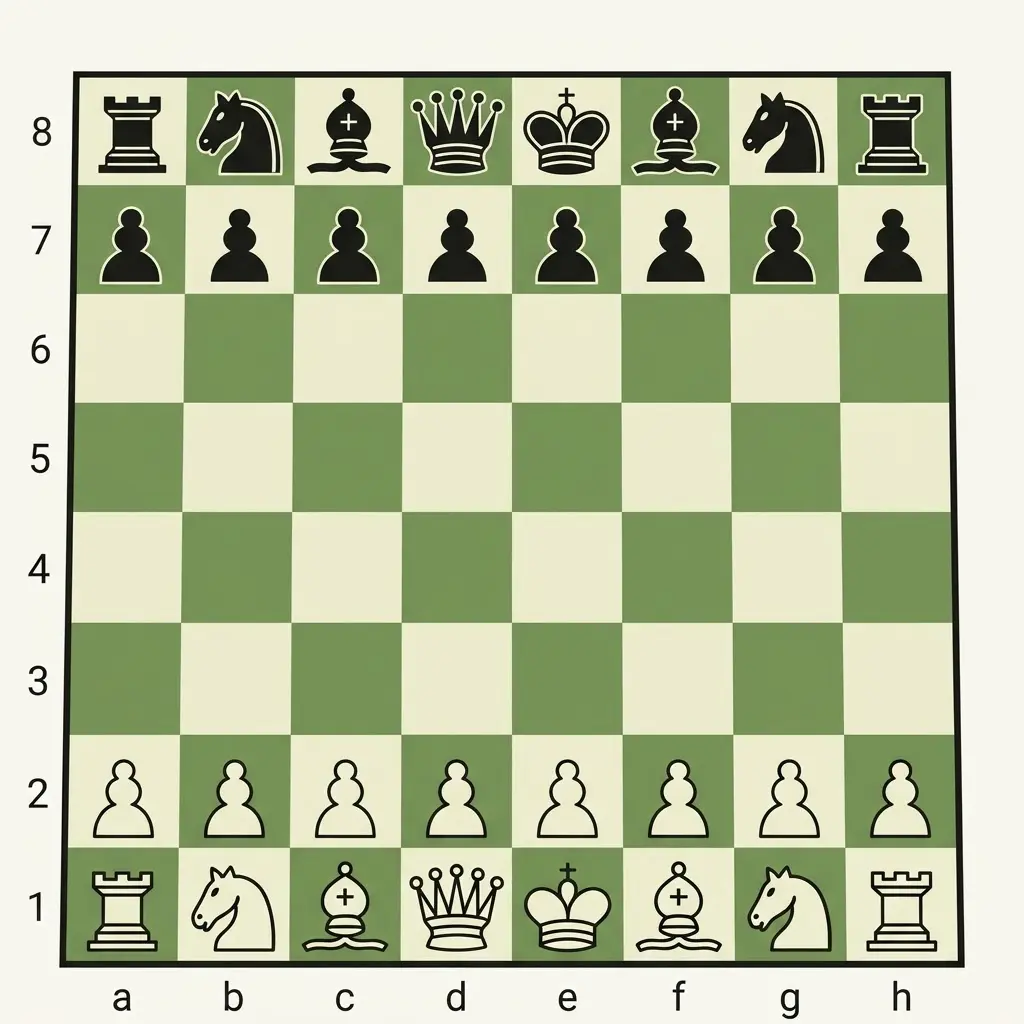
The back row, from left to right, reads rook, knight, bishop, queen, king, bishop, knight, rook, with the eight pawns in front. Each queen starts on the square of her own color. For the full step-by-step setup, see how to set up a chess board.
Which pieces matter most?
In practice, the order from most to least valuable is queen, rook, bishop and knight, then pawn. But the king is the one piece you can never lose, and the pawns decide the structure of the game. Good players use all six pieces together, instead of relying on one strong piece.
Common beginner mistakes
- Bringing the queen out too early. She can be chased, and you lose time.
- Treating all pieces as equal. A knight is not worth the same as a rook.
- Ignoring the pawns. Pawn moves can never be taken back, so each one changes your position for good.
- Trading when behind. If you are down material, trades usually help your opponent.
- Forgetting the king. Look at your king’s safety before every move.
Frequently asked questions
How many chess pieces are there? 32 in total: 16 for each player.
What are the six chess pieces called? King, queen, rook, bishop, knight and pawn.
Which chess piece is worth the most? The queen, at about 9 points. The king has no value, because it cannot be traded.
Which piece is the weakest? The pawn, worth one point, although it can become a queen.
Is a bishop better than a knight? Both are worth about 3 points. Bishops are often better in open positions and knights in closed ones.
What to learn next
Now that you know the pieces, read how each chess piece moves for the movement rules and diagrams, then the basic chess rules every beginner should know. For hands-on practice, try these free interactive lessons and a few games against the computer.