
What Is Stalemate in Chess? (Rules, Examples and How to Avoid It)
Stalemate is a draw. It happens when the player whose turn it is has no legal move, but their king is not in check. The game ends immediately, and neither side wins. For the player who was winning, it is one of the most painful ways to throw away a point.
This guide explains exactly what stalemate means, shows clear examples, and gives you a simple habit to avoid it. If you are new to the game, it also helps to know the basic chess rules first.
Stalemate in one sentence
Stalemate is when it is your turn, you are not in check, and you have no legal move.
Both parts must be true. If you are in check, it is not stalemate. If you have even one legal move, it is not stalemate.
Stalemate vs checkmate
They look similar, because in both cases the player cannot move safely. The difference is whether the king is under attack.
| Checkmate | Stalemate | |
|---|---|---|
| Is the king in check? | Yes | No |
| Does the player have a legal move? | No | No |
| Result | The player in checkmate loses | The game is a draw |
That single difference, check or no check, changes the result from a win to a draw.
How stalemate works
A legal move is any move that follows the rules and doesn’t leave your own king in check. To be stalemated, every piece you have must be unable to move legally, and your king must have no safe square to go to.
This almost always happens late in the game, when one player has very few pieces left. If you still have several pieces and pawns that can move, stalemate is nearly impossible.
Example 1: the queen and king trap
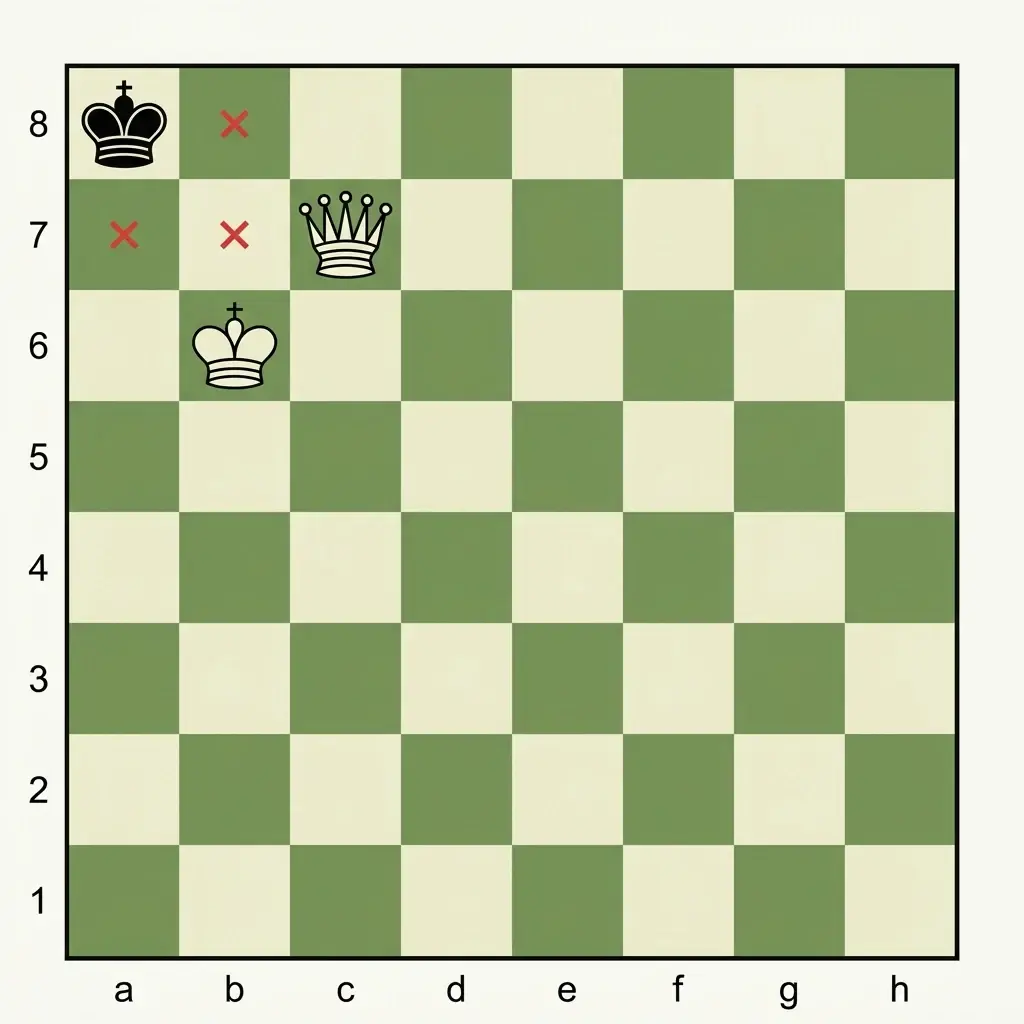
Black has only a king on a8. White has a king on b6 and a queen on c7. It is Black’s turn.
- The black king is not in check, because the queen on c7 does not attack a8.
- The king’s possible squares are a7, b7 and b8. The queen covers all three, and the white king covers a7 and b7 as well.
- Black has no other pieces to move.
Black has no legal move and is not in check, so the game is a stalemate and a draw, even though White is far ahead.
Example 2: the corner king
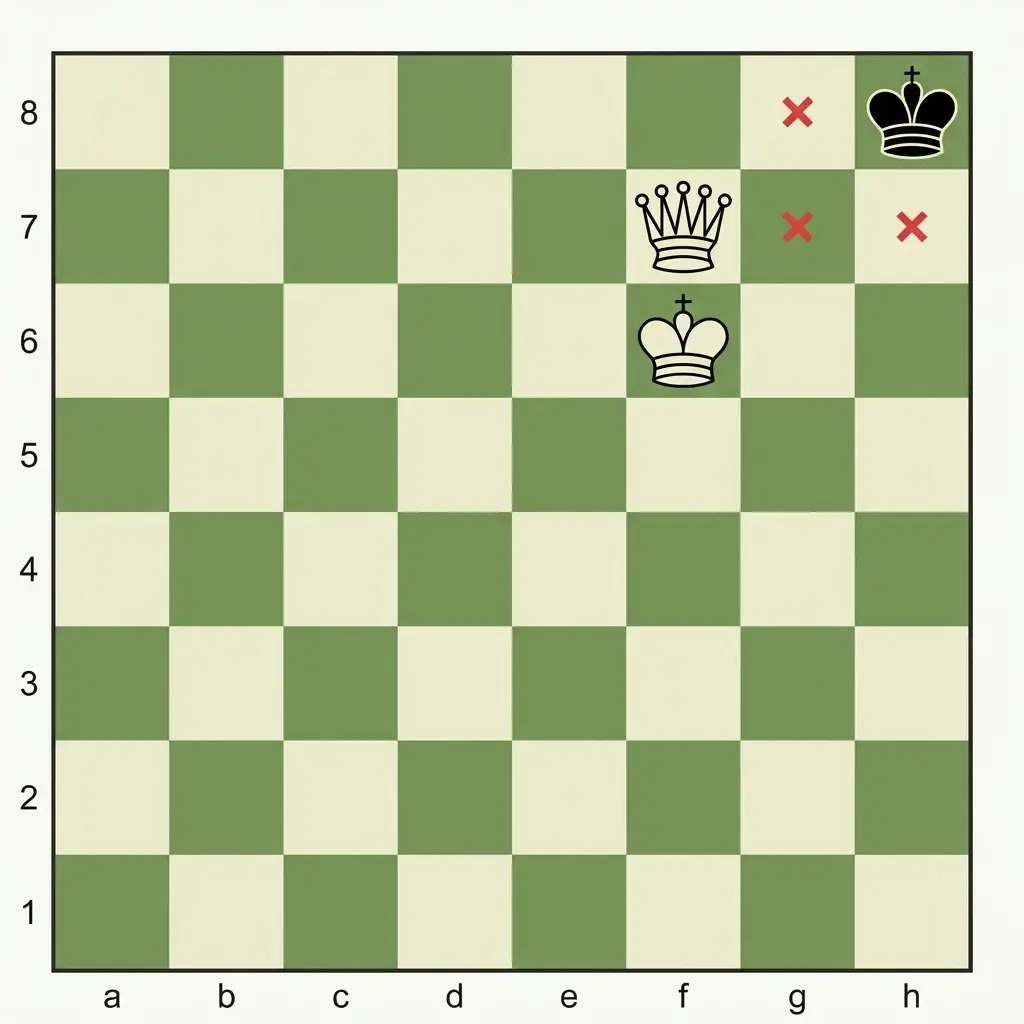
A king in the corner is the easiest to stalemate. Say Black has only a king on h8, White has a queen on f7 and a king on f6, and it is Black’s turn.
- The queen covers g8, g7 and h7, which are every square the black king could move to.
- The queen does not attack h8, so Black is not in check.
Black has no legal move, so again it is stalemate.
One move apart: stalemate or checkmate
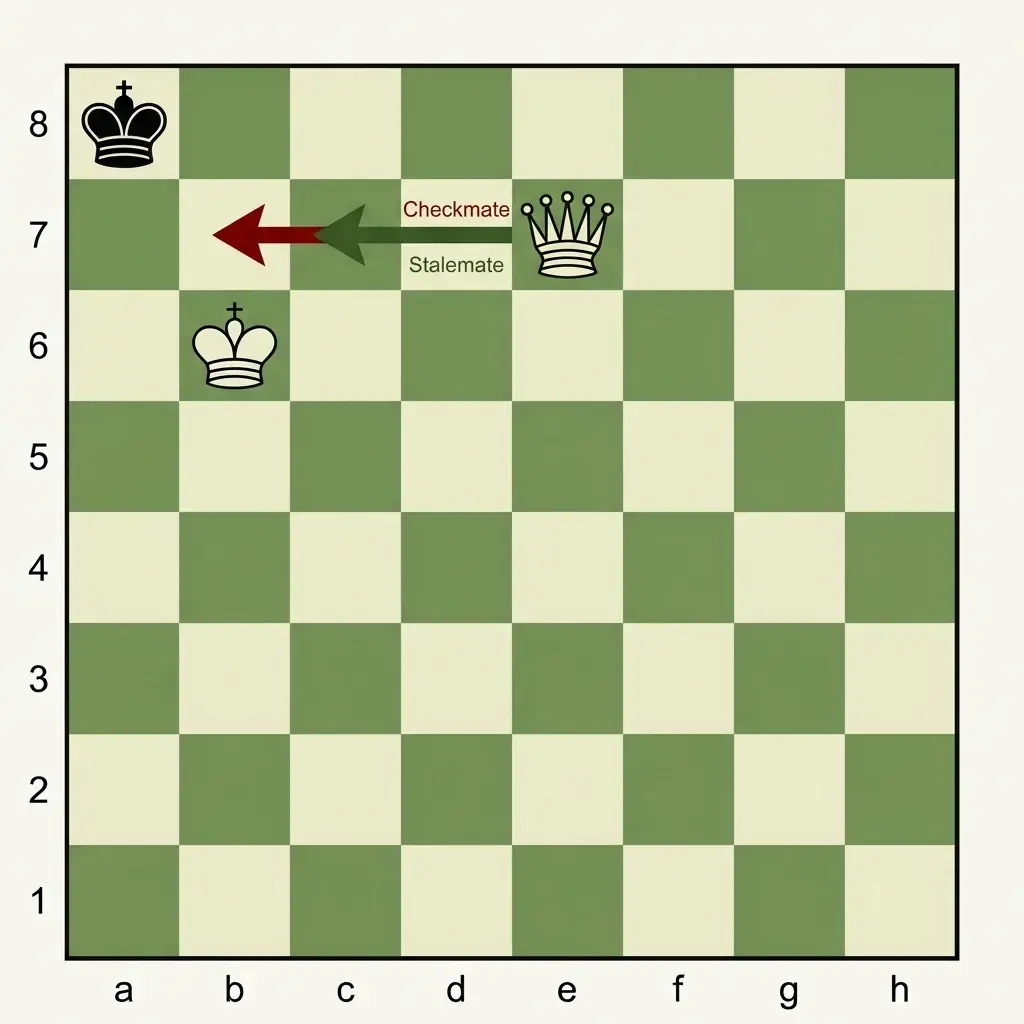
Here is the most useful lesson on this page. Take the first example, but put the white queen on e7 and let White move.
- Queen to c7 is stalemate, a draw.
- Queen to b7 is checkmate, a win.
The positions look almost identical, and one square decides the result. Before you move, always ask what your opponent can do next.
How to avoid stalemate when you are winning
Most stalemates happen because the stronger player rushes. Use this checklist before every move once your opponent has only a king, or very few pieces:
- Count your opponent’s legal moves after the move you are about to make. If the answer is zero and there is no check, stop.
- Give the king a square. Leave it one safe square to move to, and then take the net in tighter.
- Check first, if checkmate is near. A move that gives check can’t be stalemate, because a king in check isn’t stalemated.
- Don’t chase the king into a corner with your queen alone. Bring your own king closer, so you can deliver checkmate and not just take away squares.
- Keep a pawn or piece that your opponent can move, if you are happy to leave them with a move while you set up the final blow.
- Slow down. If you are ahead, you have time. A calm extra move is better than a draw.
Learning the basic checkmate patterns helps too, because you will know exactly how to finish the game.
How to use stalemate to save a lost game
Stalemate also works in your favor when you are behind. If you are down to a king against a lot of material, you can try to:
- Move your king toward a corner, where it is easiest to trap without check.
- Give away your last pieces or pawns, so you have no other moves.
- Hope your opponent takes away your last square without giving check.
This is called a stalemate trick, and strong players use it to save half a point from lost positions. Even a beginner can win a draw this way, so never resign too early.
Other ways a game can end in a draw
Stalemate is one kind of draw. A game can also be drawn by agreement, by threefold repetition, by the fifty-move rule, or when neither player has enough pieces to checkmate. You can read all of them in our chess rules guide, or in the official rules of chess.
How a draw is scored
In most tournaments, a win gives 1 point, a loss gives 0, and a draw gives half a point to each player. So stalemate is a real result that counts, not nothing.
Common mistakes
- Thinking stalemate is a win. It is a draw.
- Thinking it can happen while in check. If you are in check with no escape, that is checkmate.
- Taking away every square without checking. This is how most stalemates happen.
- Forgetting that your own pieces block you. A king surrounded by its own pieces can also be stalemated.
- Resigning when you might draw. If you are losing, look for a stalemate before you give up.
Frequently asked questions
Is stalemate a win or a draw? It is a draw. Neither player wins.
Is stalemate the same as checkmate? No. In checkmate the king is in check and can’t escape. In stalemate the king is not in check, but the player has no legal move.
Can stalemate happen with more than a king left? Yes, if all your remaining pieces and pawns are blocked or pinned and none can legally move, it is stalemate. It is rare, but it can happen.
Who wins when there is a stalemate? Nobody. Both players get a draw.
Can you be stalemated with a queen? Yes. A queen can cover many squares, which is why queen and king against a lone king is the most common stalemate trap.
What to learn next
Now that you know when a game ends in a draw, learn what each chess piece is worth and how each piece moves, then practice finishing games with a few free games against the computer.